
Grand Rapids Home Prices Per Square Foot: What the Neighborhood Numbers Really Mean
A 1,500-square-foot home in one Grand Rapids neighborhood can cost substantially more than a house of the same size a few miles away. Is the more expensive one overpriced? Not necessarily. In a market with historic houses, small city lots, new downtown condos, and homes updated at very different times, price per square foot is a useful starting point, but a terrible finish line.
If you’re comparing neighborhoods or relocating to West Michigan, this guide gives you actual neighborhood-level asking-price data, explains what the numbers do and don’t mean, and shows how we’d use them when looking at real homes. For a bigger-picture look at neighborhood character, start with our West Side versus East Side Grand Rapids guide.
Quick Answer: How Much Does a Square Foot Cost in Grand Rapids?
In a September 2026 Realtor.com neighborhood market snapshot, median *listing* price per square foot ranged from approximately $163 in Baxter to $323 in Downtown Grand Rapids among the neighborhoods selected below. Eastown was $256, Heritage Hill $258, Creston $201, and West Grand $197. Those are neighborhood asking-price indicators, not sold-home averages or quotes for any particular house. A small inventory of condos or renovated homes can move a neighborhood median dramatically.
Put another way, $200 per square foot on a 1,500-square-foot home implies a $300,000 asking price; $260 implies $390,000. That’s a $90,000 spread before we know anything about the roof, bedrooms, location, parking, lot, or monthly ownership costs. The math is simple. The interpretation is not.
Grand Rapids Neighborhood Price Per Square Foot Comparison
The table brings together Realtor.com’s September 2026 neighborhood market indicators and the neighborhood comparison tables displayed on its Grand Rapids-area market pages. Every figure is labeled as a median listing price per square foot, not a closed-sale price, appraisal or guarantee of what a buyer will pay. Because the site may update its live pages, confirm the reporting month whenever you reuse these figures.
| Neighborhood | Median listing $/sq. ft. | What to look at beyond the number |
| Downtown Grand Rapids | $323 | Condo mix, HOA dues, building amenities, parking |
| Belknap Lookout | $289 | Smaller homes, slopes, Medical Mile proximity |
| Heritage Hill | $258 | Historic architecture, restoration, preservation rules |
| Eastown | $256 | Walkable location, older homes, limited inventory |
| Fulton Heights | $222 | Home updates, lot sizes, Fulton corridor access |
| North Quarter | $209 | Neighborhood boundaries, home style and age |
| Midtown | $205 | Walkability, smaller houses, renovations |
| Creston | $201 | Block-by-block differences and renovation levels |
| West Grand | $197 | Bridge Street access versus quieter residential pockets |
| Garfield Park | $196 | Condition, floor plan, larger-home comparisons |
| East Hills | $196 | Small sample, unusual property mix, walkable corridors |
| Baxter | $163 | Condition, property type and local micro-market |
Data source: Realtor.com Grand Rapids neighborhood market data and its Eastown and Heritage Hill pages, September 2026 market indicators, checked November 3, 2026. Figures are listing prices per square foot, not closed-sale prices. Neighborhood boundaries follow the source’s definitions. Live pages may subsequently display other periods or revised figures. Recheck the reporting period and values before republishing or relying on this table.
Here’s why this matters: the apparent spread is real in the published listings, but it is not a league table of value. East Hills at $196 does not make every East Hills listing a better deal than every Eastown listing at $256. It may reflect which properties happen to be on the market, the sizes in the sample, or how each site draws neighborhood boundaries. A properly renovated house on a premium block can be priced quite differently from a home that needs major work nearby.

How Is Price Per Square Foot Calculated?
Divide a home’s asking price or sold price by the square footage being measured. A $350,000 property advertised as 1,750 square feet has an asking price of $200 per square foot. Change the price to $385,000, and the figure becomes $220. The ratio tells you the relationship between price and reported area, not whether the house is worth that amount.
Before comparing two listings, find out how each listing defines square footage. Above-grade finished area, finished basement space, and condo interior measurements are not always reported or valued the same way. A finished basement is useful, but it should not automatically be treated like a sun-filled main-floor living room. If measurements seem inconsistent, ask for clarification and verify them through appropriate listing records, measurements, or an appraisal.
Is listing price per square foot the same as sold price per square foot?
No. Listing price per square foot tells you what sellers are asking. Sold price per square foot tells you what buyers actually paid in completed transactions. Both can help, but they answer different questions. For making an offer, we would usually focus on recent, relevant closed comparable sales, then adjust for property differences, instead of applying a neighborhood asking-price median as a formula.
Why does a smaller home sometimes have a higher price per square foot?
The land, kitchen, bathrooms, utility connections, and location carry substantial value regardless of house size. That can make a well-kept 1,100-square-foot bungalow more expensive per square foot than a 2,500-square-foot home. Condos can show a similar pattern. You are not buying square footage alone; you’re buying a specific property in a specific place.
What Are You Paying For in Different Grand Rapids Neighborhoods?
If you’re new to the area you’ll notice some significant price differences from one neighborhood to the next. We’ll help explain some of the drivers of the differences you’ll see as you research the right area for your next home.
Downtown: Convenience, Condos and a Different Kind of Ownership
Downtown’s $323 median listing price per square foot stands out in this snapshot, but the housing mix is different from a neighborhood of detached homes. Here, buyers may be comparing condos, lofts and other relatively compact residences with building amenities. Square-foot comparisons can leave out HOA dues, parking costs, special assessments, shared maintenance obligations, and rental restrictions. A lower-maintenance lifestyle may absolutely be worth a premium, but you need the full monthly number.
If living close to restaurants, events and work is central to your plans, read our guide to living in Downtown Grand Rapids. Downtown’s cost and lifestyle also make more sense alongside a suburban comparison, which we will cover in
Downtown Grand Rapids vs. Grandville
Eastown and East Hills: Walkability Is Part of the Price
Eastown’s $256 median asking price per square foot and East Hills’ $196 show exactly why neighborhood-wide medians need context. Both have local business districts and older housing, yet a snapshot may include very different home sizes and conditions. Buyers often pay attention to how close a home sits to Wealthy Street, Cherry Street, or the Eastown business district, plus parking and the quality of renovations.
If you like walking to dinner or coffee, that’s a real lifestyle benefit. Just don’t let the neighborhood name do the entire job. Walk the actual blocks, check the route you would use, and compare similar properties rather than assuming one number captures the whole neighborhood. Our walkable Grand Rapids communities guide is a helpful companion.
Heritage Hill: Character and Condition Can Pull in Opposite Directions
Heritage Hill’s $258 median may reflect buyer interest in distinctive architecture and a central location, but beautiful original detail can coexist with expensive maintenance. Roofs, masonry, windows, mechanical systems and past renovations deserve close attention. Historic-district requirements may also influence exterior changes, so investigate approvals before imagining an easy makeover.
A lovingly maintained historic house and one that needs extensive restoration are not fair price-per-square-foot comparisons just because both have four bedrooms. The cost of ownership matters as much as the entry price.
Creston, West Grand and Midtown: One Label, Several Experiences
Creston ($201), West Grand ($197) and Midtown ($205) cluster in this snapshot, but they do not offer identical housing or day-to-day routines. In Creston, the property’s distance from Plainfield Avenue businesses and its renovation history may matter. West Grand buyers often weigh access to Bridge Street and downtown against a quieter block or more parking. Midtown can offer useful access to Fulton Street destinations and central-city employers.
We would compare recent closed sales of similar homes, the condition of the big-ticket systems, parking, layout, lot, and how close you want to be to a busy business district. Explore our neighborhoods for young professionals guide for a lifestyle-first view of these areas.
Garfield Park, Baxter and Other Areas: Potential Value Requires Homework
Lower median asking prices per square foot can create opportunities, but they are not automatic bargains. Two houses with the same advertised size can have very different renovation needs, financing considerations, floor plans, or resale appeal. If the savings disappear into immediate repairs, the headline number was not telling the full story.
Likewise, a higher price per square foot does not automatically mean an area is overpriced. In Grand Rapids, proximity to particular amenities, architectural quality and low-maintenance living can matter as much as the bedroom count. The sensible question is whether a particular property is competitive with *comparable properties*, not whether it falls below a citywide benchmark.
Seven Reasons the Price-Per-Square-Foot Metric Can Mislead Buyers
1. Renovations are not evenly distributed. New kitchens, updated systems, insulation and professionally executed work can add value. Cosmetic upgrades can photograph well without addressing expensive issues.
2. Age matters, but not always in the direction you expect. Older homes may have craftsmanship and location advantages while carrying greater upkeep. Newer homes may be more efficient but come with different lot sizes or fewer mature trees.
3. Condos and detached homes have different cost structures. HOA fees, building reserves, common areas and parking can change affordability substantially.
4. Square footage may not be apples to apples. Lower-level finishes, ceiling heights, room functionality and measurement conventions affect how useful the area feels.
5. Land and location are hidden in the ratio. A corner lot, walkable block, garage or quieter street can be meaningful even when the house itself is not larger.
6. A small number of listings can skew a neighborhood snapshot. A few renovated or luxury properties can change the median without representing the homes most buyers are shopping for.
7. Taxes and financing are not reflected. Your actual mortgage payment also depends on interest rate, down payment, insurance and property taxes. After a qualifying transfer of ownership, Michigan generally uncaps a property’s taxable value in the following calendar year, subject to exceptions, so the seller’s current tax bill may not reflect the buyer’s future bill. Our Grand Rapids property tax guide explains what to check.
How to Compare Two Grand Rapids Homes Fairly
Imagine you’re deciding between House A in Creston and House B in Eastown. House A is listed at $315,000 with 1,500 reported square feet, or $210 per square foot. House B is $390,000 with 1,500 square feet, or $260 per square foot. These are hypothetical examples, not current listings.
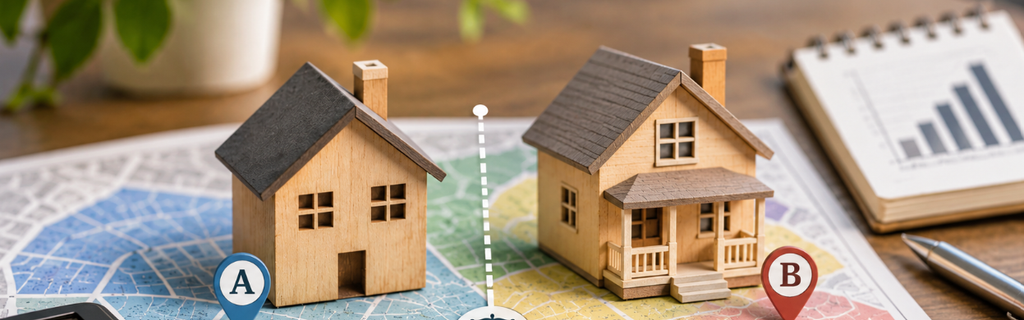
On paper, House B is $75,000 more. But say it has a newer roof, updated heating, a functional home office and a walkable location that eliminates part of your driving routine. Or perhaps House A offers a bigger yard, a garage and the quiet street you want, while leaving room in your budget for improvements. Neither answer is universally correct.
To evaluate the difference, we’d look at five buckets: similar closed sales; major condition and repair items; usable layout and lot; ownership costs; and the daily lifestyle attached to each address. Then we’d compare the total picture to your budget and time horizon. That is much more defensible than multiplying the median by 1,500.
Should Sellers Use Their Neighborhood’s Median Listing Price Per Square Foot to Set a Listing Price?
Use it as a reality check, not a price tag. Sellers can identify a rough neighborhood range and then narrow the analysis using recent sold comparable homes. Consider square footage, condition, upgrades, lot, parking and competing inventory. A house with a newly finished basement or expensive improvements does not automatically earn the same per-square-foot rate on every added square foot.
Overpricing because the house is ‘nicer than average’ can be just as costly as underpricing because a neighborhood median seems low. A local comparative market analysis considers what buyers are actually choosing between. That is the conversation May Group Realtors can help you have before your home hits the market.
What About Grandville, East Grand Rapids and the Suburbs?
These city-neighborhood figures should not be casually compared with municipal or ZIP-code figures for Grandville, East Grand Rapids, Ada or Forest Hills. The geographic units, home styles, lot sizes, school districts and property-tax considerations differ. A downtown condo and a Grandville subdivision home may have similar total asking prices while offering very different square footage, maintenance responsibilities and routines.
For a deeper lifestyle and housing comparison, see Downtown Grand Rapids vs. Grandville. If you’re still choosing among the city and surrounding communities, our moving to Grand Rapids guide is another place to start.
FAQs About Price Per Square Foot in Grand Rapids
Which Grand Rapids neighborhood has the highest price per square foot?
Among the selected neighborhoods in Realtor.com’s September 2026 *listing* snapshot, Downtown Grand Rapids had the highest figure at $323 per square foot. That does not establish the highest realized sale price, and condo-heavy inventory is not directly comparable with detached-home neighborhoods.
Is $200 per square foot a good deal in Grand Rapids?
It might be, but the figure alone cannot tell you. A $200-per-square-foot house needing major repairs may be a worse value than a more expensive, move-in-ready alternative. Compare recent sold homes of similar size, age, condition and location, then account for repairs and monthly costs.
Is Eastown more expensive than Creston?
The September 2026 neighborhood asking-price snapshot showed Eastown at $256 per square foot and Creston at $201. That suggests differences in asking prices and the mix of homes listed, not that every Eastown house costs more than every Creston house. Individual properties can overlap substantially.
Do finished basements count toward square footage?
Listings may display finished basement space differently, so confirm what the advertised square footage includes. For appraisals subject to Fannie Mae’s measurement requirements, finished below-grade space is reported separately from above-grade finished square footage, even when it is a finished walkout basement. That space can still contribute substantial value. Ask your agent or appraiser to clarify any discrepancies before comparing homes.
What is more important than price per square foot when buying?
Comparable closed sales, property condition, functional layout, location, lot, major repairs, taxes and total monthly ownership cost often matter more. Price per square foot is best used to flag questions, not to answer them all.
Find the Right Grand Rapids Home, Not Just the Lowest Number
At May Group Realtors, we want you to understand the numbers, but also what it feels like to live with the decision. A home with a higher asking price per square foot might fit your life better. Another home might give you more flexibility and a healthier maintenance budget. Both are worth considering.
Start with our Grand Rapids relocation resources and bring us the neighborhoods and listings you’re comparing. We’ll help you look beyond the quick math and assess the actual homes.