Moving to Grand Rapids, Michigan: Everything You Need to Know Before You Go
So you decided you’re moving to Grand Rapids, Michigan. We’re excited to have you, but before you load up the moving truck, there are a few things you should know that nobody tells you until it’s too late.
This guide covers the real Grand Rapids experience: what newcomers get wrong, what makes the city genuinely special, and what life actually looks like once you settle in.
Is Grand Rapids a Good Place to Live?
Short answer: yes, and increasingly so.
Grand Rapids is one of the fastest-growing mid-size cities in the Midwest. It offers a rare combination of affordability, livability, and opportunity that has become harder and harder to find in most American metros. The city has a walkable, distinct downtown, tight-knit neighborhoods with real character, a booming food and craft beer scene, and proximity to Lake Michigan. It is not trying to be Chicago, and it does not need to be.
For families, professionals, and anyone escaping the cost and chaos of a major metro, Grand Rapids consistently delivers on the promise of a high quality of life without the trade-offs that usually come with it.
What Should Newcomers Know First?
Michigan Is a Title State
This is the thing that trips up almost every newcomer moving to West Michigan from certain parts of the country, and it is worth understanding before you get to the closing table.
If you are relocating from what is called an attorney state, places like Georgia, New York, Massachusetts, or South Carolina, you are used to having a lawyer sit beside you at closing and walk you through every document. In those states, an attorney is legally required to be part of the real estate closing process.
Michigan works differently. Here, a licensed title company handles your closing. That means no attorney is required to be present. The title company reviews the chain of ownership, manages the paperwork, and ensures the title is clear before it transfers to you.
This does not mean you cannot hire a real estate attorney. You absolutely can, and for complex transactions, it may be worth it, but the process will likely feel different than what you are used to. The best advice: lean on your real estate agent, ask questions early, and get comfortable with your title company. They do this every day, and they are very good at it.
Rethink Your Commute Math
Here is something almost every out-of-towner gets wrong when they start house hunting in Grand Rapids.
When people relocate, they tend to apply the mental math they used back home. If you are coming from Dallas, Denver, or DC, a 30- to 40-minute commute probably sounds perfectly reasonable, maybe even comfortable. In a large metro, that puts you in a nice suburb still well within the city’s orbit.
In Grand Rapids, 30 to 45 minutes from downtown could put you in a completely different county.
That is not an exaggeration. Because traffic moves efficiently and the roads are open, thirty minutes in Grand Rapids might land you in Lowell, Rockford, Byron Center, Hudsonville, or even Holland, depending on the direction you are heading. All fantastic areas, but farther out than most newcomers realize.
The recalibration you need: think in miles, not minutes. A reasonable commute downtown is probably somewhere in the 10- to 20-minute range, and that still gives you an enormous amount of the metro area to explore. You can be in Ada, Cascade, Kentwood, Wyoming, Grandville, Walker, or Comstock Park and still be close to everything.
The sweet spot that surprises most newcomers is just how much house, yard, and neighborhood you can get within 15 to 20 minutes of downtown. In Chicago or Atlanta, 15 minutes from the urban core puts you in an apartment or a condo. In Grand Rapids, it might put you in a four-bedroom home with a backyard on a quiet street.
When working with your real estate agent and setting your search radius, resist the instinct to think big. Think closer than you are used to. You will be surprised.
How Affordable Is Grand Rapids?
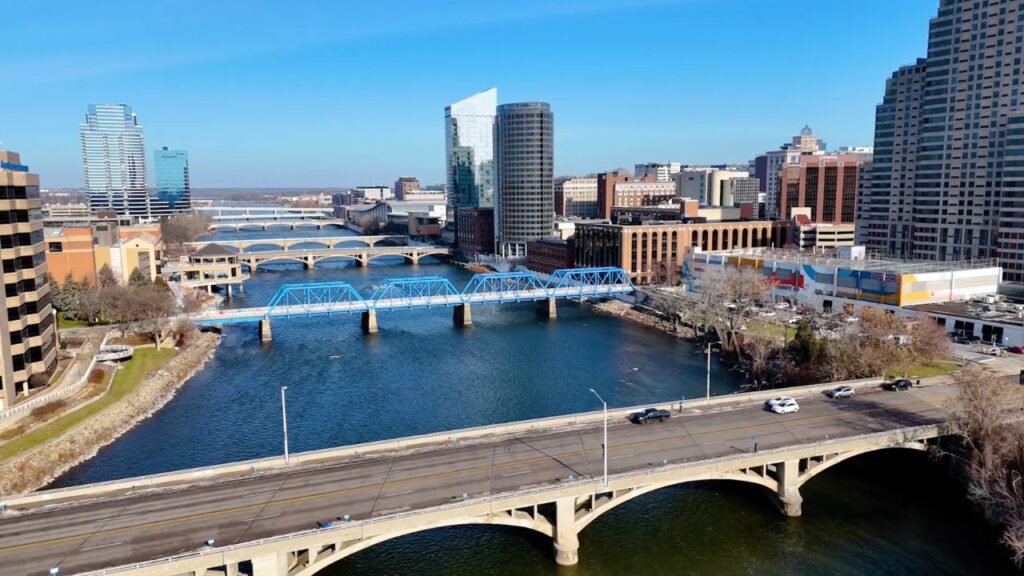
Grand Rapids consistently ranks as one of the more affordable mid-size cities in the country, especially when compared to coastal metros or even nearby Chicago. Housing is the headline. The same budget that gets you a one-bedroom condo in a major city can get you a detached home with outdoor space in a desirable Grand Rapids neighborhood.
Groceries, utilities, and everyday expenses also tend to run lower than national averages. The city does not have a state income tax surprise waiting for you either: Michigan has a flat income tax rate, which is straightforward to plan around.
The affordability is not a hidden secret anymore. It is part of why Grand Rapids has attracted consistent in-migration from higher cost-of-living metros over the past several years. The value is real, and it is visible once you are looking at actual listings and actual grocery receipts.
Neighborhood Overview
Grand Rapids is made up of distinct, walkable neighborhoods, each with its own personality. This is one of the things longtime residents love most about the city and something newcomers often do not expect.
A few areas worth knowing:
Downtown and near-downtown corridors like the Medical Mile, Monroe North, and Midtown attract professionals and young residents drawn to walkability, restaurants, and proximity to major employers. These areas have seen significant investment and development in recent years.
East Grand Rapids and Forest Hills appeal to families looking for strong school districts, mature tree-lined streets, and a suburban feel that is still close to the city core.
Ada and Cascade offer a more upscale suburban character with larger lots, newer construction, and easy highway access.
Wyoming, Kentwood, and Grandville on the south and west sides of the metro offer strong value, diverse communities, and convenient access to retail corridors and major employers.
Walker and Comstock Park to the north are growing steadily with solid affordability and a quieter residential feel.
The key takeaway: Grand Rapids rewards doing your neighborhood research. Each pocket of the metro has a distinct identity, and finding the right fit for your lifestyle makes a real difference in how much you enjoy the city day-to-day.
Weather and Seasons
There is no polite way to say this: Michigan winters are real. Grand Rapids sits in the Lake Michigan snowbelt, which means it sees more snow than many Midwest cities of comparable size. Lake effect snow is a genuine phenomenon here, and some winters bring accumulation that surprises people from flatter, drier climates.
That said, locals do not just endure winter. They engage with it. Cross-country skiing, snowshoeing, ice skating, and winter festivals are part of the cultural fabric.
Spring arrives a little later than you might hope, but it tends to be beautiful once it shows up. Summers in West Michigan are genuinely exceptional, with mild temperatures, low humidity compared to the rest of the Midwest, and easy access to Lake Michigan beaches that are among the best freshwater shorelines in the country. Fall foliage is stunning and stretches for weeks.
The honest version: if you have lived in a place with four distinct seasons, Grand Rapids will feel familiar. If you are coming from a warmer or drier climate, give yourself one full winter before you make any judgments. Most people come around.
Jobs and Lifestyle
A Growing Economy With Real Depth
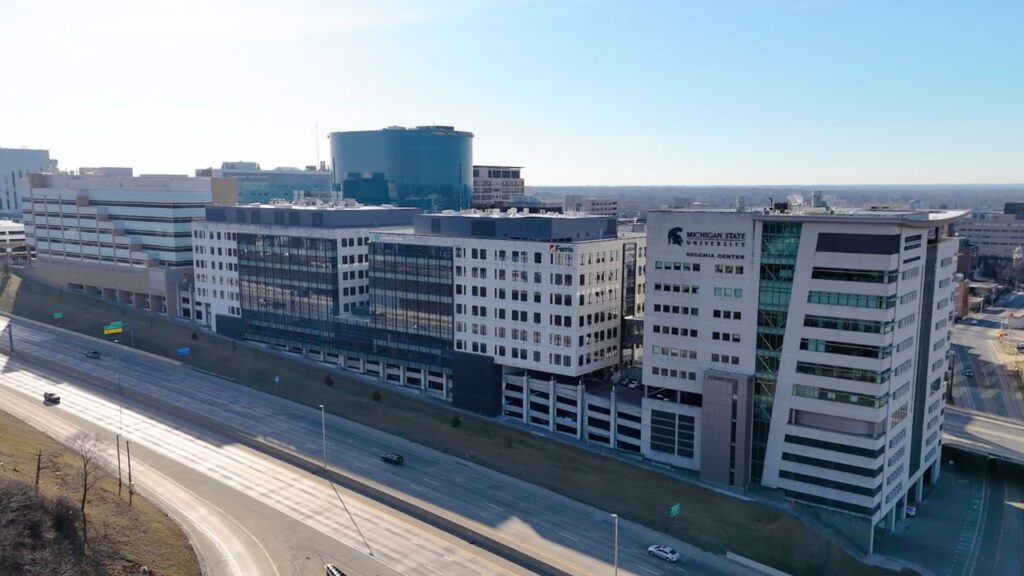
Grand Rapids is not a one-industry town. The metro’s economy spans healthcare (anchored by a dense cluster of major hospital systems along the Medical Mile), manufacturing and advanced manufacturing, professional services, tech, and a robust food and beverage industry that has gained national recognition.
Major employers include Spectrum Health, Corewell Health, Amway, Steelcase, Meijer, and a growing number of mid-size tech and logistics firms that have made the city a regional hub. The presence of several universities, including Grand Valley State University, Calvin University, and Aquinas College, contributes to a steady pipeline of talent and a vibrant young-professional community.
Getting In and Out of Town
One aspect of Grand Rapids that often surprises newcomers is the quality of its airport. Gerald R. Ford International Airport (GRR) is Michigan’s second busiest, handling more than four million passengers annually with nonstop service to over 30 destinations.
It is also in the middle of a significant expansion. Project Elevate, a more than $500 million investment in the airport’s future, includes a newly expanded Concourse A with eight new gates and a $135 million terminal enhancement project that broke ground in 2024. As part of this expansion, GRR became the first small-hub airport in the United States to implement a state-of-the-art consolidated baggage inspection system, meaning faster and smoother bag handling on the backend.
The practical takeaway: you are not driving to Detroit to catch a flight. GRR is a legitimate, award-winning, rapidly growing airport that makes travel genuinely convenient from West Michigan.
Traffic (Yes, Really)
Grand Rapids runs on a sensible grid system in its core, and highway access via US-131, I-196, and I-96 functions well. Locals will tell you with complete sincerity that the Wealthy Street construction or the 28th Street corridor on a Saturday is brutal. And they believe it.
For anyone who has ever commuted through actual gridlock, this will be the most pleasant adjustment you make. The metro area is compact enough that you can get from one side to the other in about 20 to 25 minutes on a normal day. The time you get back when you are not sitting in traffic is not a small thing. It compounds across weeks and months in meaningful ways.
Fair warning: give it six months, and you will start complaining about the traffic, too. It is a rite of passage. Everyone does it.
Food, Culture, and Community
Grand Rapids earned its “Beer City USA” nickname more than once, and the craft brewing culture here is genuine and deep. Beyond beer, the restaurant scene has grown significantly over the past decade with strong local ownership and a wide range of cuisines.
The arts and culture infrastructure is stronger than most mid-size cities can claim. The Grand Rapids Art Museum, Frederik Meijer Gardens and Sculpture Park, ArtPrize (a large-scale international public art competition), and a busy calendar of festivals and events give the city a cultural energy that residents consistently cite as a reason they stayed.
The Bottom Line on Moving to Grand Rapids
Grand Rapids is growing fast, and the people relocating to Grand Rapids are arriving for good reasons. The affordability is real. The neighborhoods have genuine character. The job market has depth. The quality of life, measured in commute times, green space, access to the lake, and a community that still feels like a community, is difficult to match at this price point anywhere in the country.
Understand the title process, and you will close on your home without a hiccup. Adjust your traffic expectations, and you will wonder why you did not move here sooner. And the next time you fly out of GRR and breeze through the newly expanded concourse, you will know you landed somewhere that is genuinely on the rise.
Have questions about buying a home in the Grand Rapids area? Reach out to the May Group Realtors at RE/MAX of Grand Rapids. We help newcomers navigate every step of the process.