
Key Considerations for Moving to Grand Rapids with a Family
Moving to a new city is exciting—until you’re trying to pick a neighborhood, understand schools, and figure out whether that charming older home will need a new roof and a new furnace. If you’re considering moving to Grand Rapids with a family, this guide focuses on the practical choices that matter most—especially if you’re leaning toward buying a home inside the city.
Below you’ll find a clear decision framework, a homebuying-first lens, and a weekend recon itinerary you can use to test-drive the best Grand Rapids neighborhoods for families before you commit.
1) Start with your “family priorities list” (before you look at houses)
Before you compare neighborhoods or tour homes, get aligned on what matters most to your family. This prevents the common trap of falling in love with a house and realizing later it doesn’t fit daily life.
Pick your top 5 priorities:
- Commute time (to work, downtown, or main highways)
- School fit (neighborhood school, theme/charter options, extracurriculars)
- Walkability (parks, library, coffee shops, sidewalks)
- Home style (older craftsman vs newer build; yard vs nearby parks)
- Kid logistics (childcare availability, after-school care, activities)
- Budget comfort (purchase price + taxes + utilities + maintenance)
Pro tip: Decide what you’ll compromise on now. For example: “Smaller yard is okay if we’re near a park,” or “We’ll trade walkability for a bigger house.”

2) How to evaluate Grand Rapids neighborhoods for families (city-first approach)
City living can mean shorter drives, more neighborhood character, and easier access to parks and cultural amenities—but the “right” fit is highly block-specific. Instead of relying on vague opinions, use a repeatable process:
Use official neighborhood tools to get oriented
The City of Grand Rapids provides a Neighborhood Lookup Map so you can confirm neighborhood boundaries and explore neighborhood-level information.
Visit like a local, not a tourist
When you’re narrowing down areas, drive and walk the neighborhood at:
- Morning school-drop-off time
- Late afternoon (traffic + after-school energy)
- After dark (lighting, parking, noise)
Look for family “signals” on the block
- Sidewalks and crosswalks that feel safe with kids
- Traffic speed and visibility at corners
- Strollers, bikes, and people using porches and parks
- Proximity to playgrounds, libraries, and community centers
If you’re also thinking about safety and services, the city’s police department organizes the city into neighborhood service areas and encourages residents to connect with their local team.
Neighborhoods: use a framework first, then apply it to examples
Grand Rapids is block-by-block. Instead of trying to “rank” neighborhoods, compare them using the same criteria each time:
A simple neighborhood scorecard
- Daily convenience: groceries, school routes, errands, parking
- Walkability: sidewalks, crossings, parks, kid-friendly routes
- Housing stock: age, typical lot size, renovation level
- School access: assigned schools + realistic commute to alternates
- Weekend life: playgrounds, activities, family events nearby
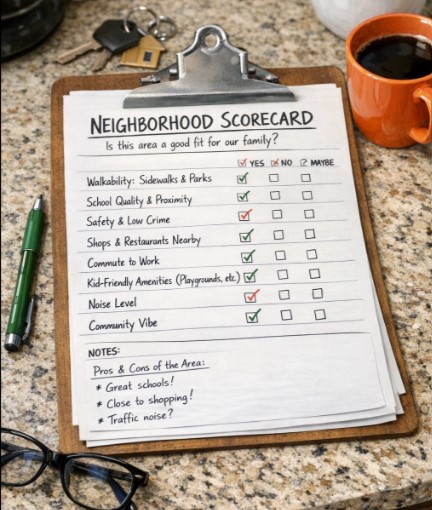
Examples of where to apply this framework
These neighborhoods are popular locations that offer good opportunities to test out your scorecard:
- Alger Heights: often associated with a walkable “small-town” feel, with a recognizable business district and family routines that can be done on foot (library/shops/food).
- Creston–Cheshire: a large area close to downtown with access to parks/trails and a mix of housing types—useful if you want space and neighborhood amenities without feeling far out.
- Eastown: a notably walkable district with busy sidewalks, shops/restaurants, and historic homes—great for families who want “city energy” and easy outings.
- Fulton Heights: mostly residential and close to downtown, often described as quiet/homey with neighborhood-scale green space (good if you want calm streets with quick access to city hubs).
- West Grand: a west-of-the-river area with older homes and multiple parks—worth scoring if you want proximity to downtown while still having neighborhood organizations and green space nearby.
Check out our post: Grand Rapids With Kids: A Complete Guide for Families
3) Buying a home in Grand Rapids: what families should know (especially with older homes)
Many city neighborhoods feature older housing stock—beautiful, but sometimes maintenance-heavy. If you’re leaning toward buying, plan for both purchase price and ownership costs.
What to watch for when touring older homes
- Foundation and water management: grading, gutters, sump pump, basement moisture
- Roof age and attic ventilation
- Electrical panel capacity (and any outdated wiring)
- Plumbing updates (materials, water pressure, signs of past leaks)
- Windows + insulation (comfort and heating costs in winter)
Tip: In competitive markets, it’s tempting to waive inspections. If you do, at least consider a pre-offer inspection or specialized add-ons (roof/sewer scope) depending on the property.
Budget beyond the mortgage
Even if you don’t quote exact numbers in the blog post, it helps readers to think in categories:
- Property taxes and escrow changes
- Utilities (winter heating can be a real swing factor)
- Routine maintenance (filters, gutters, snow removal tools)
- “Old house” surprises (appliances, minor repairs, tree work)
4) Schools in Grand Rapids: boundaries, options, and how to research quickly
If you’re buying in the city, school planning often starts with attendance boundaries—then expands to other options that may fit your child better.
Grand Rapids Public Schools (GRPS) explains that neighborhood schools have attendance-area boundaries determined by address, and families can use tools to locate assigned schools.
Quick steps families can follow
- Check the attendance-area tool for your potential address (or a nearby intersection).
- Review enrollment requirements and timelines so you don’t get surprised by paperwork or deadlines.
- If relevant, look into theme school options (GRPS notes a theme school application process).
What to compare (without getting overwhelmed):
- Daily start/end times and transportation options
- Before/after care availability
- Special education supports and services (if needed)
- Extracurriculars that matter to your child (sports, music, STEM, language)

5) Childcare and after-school care: plan earlier than you think
Even if your kids are school-aged, childcare affects real life—work schedules, commute choices, and your ability to say yes to a house farther from your “core.”
Smart planning moves:
- Start calling daycares once you have a shortlist of 2–3 neighborhoods
- Ask about waitlists, schedules, and part-time options
- Build a backup plan (family help, flexible work days, sitter list)
6) Daily logistics: commuting, parking, and getting around with kids
When you’re city-based, your routine is less about “miles” and more about:
- How quickly you can cross town during peak times
- How comfortable you feel with winter driving on your regular routes
- Whether errands can be combined in one trip (school, groceries, activities)
Neighborhood test: On your recon weekend, run a mock weekday route: neighborhood → school area → grocery stop → downtown → back home.
7) Healthcare access and family routines
When families relocate, healthcare tends to get handled late—until someone gets sick the first month.
A simple system:
- Choose a pediatrician and primary care provider early
- Identify nearby urgent care options
- Transfer records before the move (especially immunizations and any ongoing care)
8) Weather reality check: winter readiness for newcomers
Michigan winters don’t have to be intimidating, but they do reward preparation—especially with kids.
Family winter checklist (city version):
- Snow brush + shovel + driveway salt
- Cold-weather layers for kids (especially waterproof gear)
- A plan for school delays/closures and backup childcare
- A house “comfort check” (drafts, insulation, furnace maintenance)
9) Weekend recon itinerary (a practical “test-drive Grand Rapids” plan)
Use this weekend to answer one question: Can we picture our daily life here? Not “Was it fun?”
Friday evening: first impressions + neighborhood feel
- Check into a hotel or short-term rental near your top area
- Take a 20–30 minute walk: sidewalks, lighting, traffic, noise level
- Grab dinner nearby and note drive/parking ease
Saturday: neighborhoods + homebuying reality
Morning
- Drive through 3–5 neighborhoods (don’t overdo it)
- Stop at a local park or playground to see how busy it gets
Midday
- Tour a few homes (or open houses) across your price range
Goal: understand typical house size, condition, and renovation level.
Afternoon
- Do a “kid-friendly anchor activity” to test quality of life.
Experience Grand Rapids highlights family-friendly options like the Grand Rapids Public Museum and the Grand Rapids Art Museum’s family programming, plus Blandford Nature Center.
Evening
- Drive a mock weekday route during peak traffic time (even if it’s Saturday, you’ll still learn a lot)
- Note grocery store access and general convenience
Sunday: schools + services + decision clarity
- Map out school locations for your top addresses using GRPS tools.
- Visit a library branch or community space (great “family fit” indicator)
- Look up city services you’ll actually use (trash/recycling, utilities).
- Before you leave, write down:
- Top 2 neighborhoods
- 3 non-negotiables
- 3 concerns to research next
10) First-30-days moving checklist (Michigan essentials included)
Once you establish Michigan residency, the Secretary of State lists key steps for new residents such as applying for a Michigan license/ID and getting Michigan plates for vehicles.
Practical first-month checklist:
- Set up utilities and internet
- Register kids for school and confirm transportation/care
- Transfer medical/dental records
- Update driver’s license/vehicle registration (and voter registration if needed)
- Build your “local roster”: pediatrician, urgent care, pharmacy, a go-to park
FAQ: Moving to Grand Rapids with a family
Is Grand Rapids a good place to raise a family?
It can be, especially if you match neighborhood + school + daily logistics to your routine. The city offers family activities and amenities, but the best fit depends on commute, school needs, and the vibe you want day-to-day.
How do I choose a neighborhood in Grand Rapids?
Start with your priorities, use the city’s neighborhood tools to orient yourself, and do a recon weekend with walks at different times of day.
How do school boundaries work in the city?
GRPS neighborhood schools have attendance boundaries tied to your address, and families can use the district’s attendance area tools to identify assigned schools.
Should we rent first or buy right away?
If you’re confident in your top neighborhoods and school plan, buying can work well. If you’re unsure, a short-term rental or a slower search can reduce regret—especially with kids.
Grand Rapids – Your Family’s Destination?
Grand Rapids can be a strong choice for families—but the best move is the one that matches your daily life. Focus on (1) neighborhood routines, (2) school fit, (3) homeownership realities, and (4) seasonal readiness. Then use the recon weekend to confirm the “feel” you can’t get from listings and map pins.
If you’d like some more help in finding the right fit in Grand Rapids, contact the May Group today and our team will be happy to help you out!